Monday, June 3, 2019

Can You Make Wine From Other Fruits?

We generally think of wine as a beverage made from grape juice, but can you make wine with other fruits? Well yes you can. Even the U.S. government’s Tax and Trade Bureau defines wine as being made from grapes, other fruit, and even other suitable agricultural products.

In fact you can make wine with many fruits such as damsons, elderberries, bananas & coconuts. Even rhubarb which is a vegetable. Often these wines are made in sweeter styles, and are always consumed young.

Why are grapes the prime ingredient?

However there are reasons grapes are the prime ingredient. The grape the only fruit with the right combination of sugars, juice and yeast on the skin to make fermentation and the production of an alcoholic beverage a natural process. To make wine from other fruits you have to mash the fruit and usually add water. Then have all sorts of adjustments to make, such as adding tartaric acid, sugar, tannins and so on. As a side note, you might like to know how to go about making your own country wine, and you can find out here.

Chart Showing The Sugar Content of Various Fruits


Grapes on the other hand contain enough tartaric acid, tannins that will naturally turn them into a beverage that has a good mouth feel. Well almost...making quality wine is a little more complex than waiting for nature to take its course. However somewhere in the history of mankind, someone somewhere drank some grape juice that had fermented, and they liked the experience. Wine was born! For a more in depth article click here.

Wednesday, May 22, 2019

Why Does Wine Need To Air?

A not too technical explanation on airing wine


What happens when you expose wine to oxygen, and why does wine need to air? Is it really necessary or is it just another snob thing? Unfortunately there isn't an answer good for all occasions. For some wines it's essential, while for others it's superfluous. So here's a not too technical explanation. Alternatively if ever in Italy you may like to take a wine class with me at Monterinaldi winery. More info on my tours here, and the Monterinaldi estate here.

Why does wine need to air in a decanter
Decanted Super Tuscan wine from Monterinaldi


What happens when air & wine Interact?

When our precious liquid comes into contact with air, two processes take place. Namely: evaporation and oxidation. These processes improve the quality of wine by changing its chemistry.

Evaporation

When wine evaporates elements known as  volatile compounds will instantly leave the liquid.  Two of these compounds are undesirable, so the sooner they leave the better. They are Ethanol and Sulfites. Ethanol has a medicinal odor, and Sulfites which are used as a preserve smell like burning matches. While present they will tend to cover the other more pleasing odors. Fortunately it doesn't take long for them do dissipate.

Oxidation

Oxidation is the same process that causes cut apples to turn brown and iron to rust. In simple terms the wine is breaking down. It's the very process of breaking down which is responsible for releasing the pleasant aromas which reach our nose and taste buds. Of course, over a number of days the oxidation process will make the wine very unpleasant to drink, but initially it's the exact opposite.


Do all wines need to air?

No they don't. Generally speaking whites and roses don't benefit from aeration because they don't contain the high levels of pigment molecules found in red wines. It's these pigments that change flavor in response to oxidation. Also cheaper red wines tend not to improve either. In fact, oxidation may make them taste flat after half an hour and bad after an hour! This because they're not made entirely with grape juice, and consequently don't have the same number of fruit derived molecules as a quality wine.

Methods of aerating wine

The best methods are the bottle or the decanter. Well there's also the glass, but this is the last stage. Aerators are a waste of time, because the air to wine contact is s split second which is way too short.

The bottle: The surface area of the neck is very limited. Consequently aerating will need a considerably longer time. Two/three hours for a young wine, and up to eight hours for an aged and structured product. The bottle should be left without the cork.

The decanter: Most definitely the best way is the decanter. The decanter will allow the wine to be exposed over a large surface area. Here a half hour to an hour is usually sufficient

The glass: If you don't have decanter, you can pour the wine back and forth between two containers or simply swirl the wine in your glass before drinking it. Actually a very brief swirl before every sip is something I always do. Just a couple of spins, no more.

You can learm n

Happy drinking!

Wednesday, May 1, 2019

Sweet Wines For Beginners

If you're new to wine and have a sweet tooth, you could be wondering if there are sweet wines for beginners? You may also have heard a few negative comments about them, and the experts (mainly men), see them as something for women or people who know nothing about wine. Read on and you'll find there's something just for you.

Vin Santo sweet wine from Tuscany
It's true that many sweet wines are made with things other than grape juice, and it's not a bad idea to keep away from them. There are however others that certainly deserve consideration. Some "experts" even rate wines such as Ice Wine, Rieslings, and Sauternes as high as their dry counterparts. You can read the definition of a sweet wine here.

So what's responsible for the bad reputation? Well, the wines with the bad reputation are generally the cheaper ones. And the bad rap is justified. I'm referring to wines under $10 where sugar and other additives are used to mask the poor qualities of the fruit. If a winemaker makes a mistake, or when the juice is of high volume but low quality, the quickest ways to hide imperfections is to add sugar. Because the sugar’s flavor is so dominant and pleasing to our palate, we don't notice the flaws.


You're going to have to spend a little more if you want quality

The best sweet wines for beginners and for anyone else for that matter, are those where the wine making methods concentrate the natural sugars present in the fruit. This may be because the fruit is allowed to over ripen, it's frozen, or it's been dried. No additional sugar is added to hide something, and the sweet flavor is the natural result of the winemaker’s techniques. These processes require more work and low yields, consequently the price tag is a little higher. However for the most part they're still affordable. As I'm biased the best wines come from Italy and are made from dried grapes. See below.


Suggested sweet wines for beginners

Riesling. Originally from Germany, also found in Austria, Australia,  New Zealand & the US. The wine has a wide stylistic range, from complex, dry to very sweet.

Sauternes. From the Bordeaux region of France. Again there are many styles of this white wine, and they're best served lightly chilled.

Recioto della Valpollicella. Intensely flavored, and made from dried (passito) grapes in the Veneto region of north-eastern Italy

Vin Santo. Vin Santo again made from dried grapes. It can vary in sweetness from dry to extremely sweet. The Vin Santo from Monterinaldi estate winery which we can visit on one of my private Tuscany wine tours has won many awards. In my opinion rightfully so. A gorgeous sweetness when it first as it hits the palette, followed by a touch of acidity to keep it from being overpowering. An absolute perfect balance. And to top it all its an all natural product made from dried grapes not sugars. Another bonus is that the wine will keep indefinitely, like a liquor. Take a drink today, and put the cork back on the bottle. It will be fine in a year's time if you can wait that long.

Thursday, April 18, 2019

Beginners Guide To Wine Tasting

Many of my guests feel the need to apologize for their lack of wine knowledge. If you're thinking of taking a Tuscany wine tour with me, you don't need to. It will be my job and pleasure to help you through the process. However, here are a few light hearted tips to debunk all the snobbery and make you feel more at ease.

Tuscany wine tasting tour with Sergio of scenic wine tours in Tuscany


Before the big day 1 to 6

1. Buy a bottle of wine and a glass so you can practice a few simple techniques. If you don't know them, you'll always be a novice. The glass is like the one below and a cheap wine suffice, but if you're considering a trip to Tuscany go for red.

2. Hold the glass by the stem or the foot. Don't ever hold it in your fist, it just looks so unrefined!

3. Fill the glass ¼ full then incline it so you can observe the edge of the liquid in transparency. Hold it up to the light, or if there's a white surface, against the surface. Observe if the edge is dark or if you can see through it. Then observe the color; is a deep red, violet or does it have a slight brown tint.

The glass for red wines

Look the part

4. If you want to look just right, you must practice the swirling technique. Get it wrong or don't do it, and you're telling everyone you're new to the game. The process gets oxygen into the wine which will help release all the aromas. The easiest way to swirl is to hold the glass to the table by the stem, and make rapid circular movements. You must aim to create a concave cone with the liquid. If the glass is correctly filled by about a ¼ it won't come out, so go about it vigorously.

5. Swirl the wine for about three seconds, then put your nose well into the glass taking a deep sniff. Wait about twenty seconds and do it again. See if you can associate the aroma with something else you know. Red wines will generally smell of other red fruits and jams. If the wine has been barrel aged there will be a hint or even a definite note of spice as well. If you can't don't worry. This is something that can take time as most of us aren't used to using our sense of smell. Women tend to have a better sense of smell then men.

A typical somellier


Take a sip and slobber

6. Now take a sip, and very briefly hold the wine in your mouth and swallow. Now take another small sip, but this time keep it in your mouth and draw in air mixing it with the wine. You can find your own way to do this, the easiest for most people is to draw in over your closed teeth. Roll the wine around your palate for about ten seconds, then swallow. Don't be afraid to slobber, It's perfectly acceptable at a wine tasting.

At this point concentrate on the sensations you're receiving. With red wines the first thing to observe is the puckering sensation. Did you find it pleasant, or did it bother you? Now observe if the wine is acidic, bitter, sugary or dry, and how do these sensations take you. Do you like them or not? At the end of the day that's what it's all about. You either like what you're tasting or you don't and it's the same for everyone.

So that's it! You now know the basic of how to taste wine.

At the winery

You're now in the tasting room and as a beginner the best advice I can give you is to admit you're new to wine and still learning. Once you've done this you're unassailable. Never and I mean never, drink the wine like a shot. Just take your time and go through points 2 to 6, and you'll get full marks even from the most conceited snob.

If you're in doubt, just don't say anything. However sensations are personal and not really debatable. So if your smelling a sweaty horse in your glass, then say so.

However at all times just remember the following

• No one knows everything about wine.
• Don't be afraid to ask “dumb” questions.
• Wine is to be enjoyed not intellectualized.
• Expensive doesn’t necessarily mean better.
• If it doesn't have to be expensive, don't trust very cheap either.
• Beauty is in the eye of the beholder and also in his taste buds.
• Don't be afraid to experiment. 

Monday, March 7, 2016

The Best Time to Travel in Tuscany

So when is the best time to travel to Tuscany? Well I’m of the opinion that Travelling in Tuscany is a year round activity and every season has its charm. Of course winter in Tuscany is cold, but it’s not that bad; expect day time temperatures of 5-10 centigrade (40-50 Fahrenheit).

The winter months are best for cultural tours of cities and museums because you won’t have to deal with the high season crowds. The main cities such as Florence Rome and Venice never close down, but being low season there's ample choice of accommodation at considerably cheaper prices. There's something of a myth about August, which claims that everything closes down for the holidays. While this is true for small towns and industry, all the major tourist attractions are more than open. This includes wine country and wineries.


Tuscany wine country landscape
One Of The Scenes From My Tours
If the the Tuscan scenery is high on your list of preferences, then visit from the end of April to the end of October. The foliage is rich and you'll get some great photos. The less busy periods for wine tasting are March, April & November. 

As the Tuscan countryside is quite a large area, travelling at any time of the year isn't too much of a problem. However in summer and autumn be prepared for crowds at the wineries. If you're travelling without a guide, I strongly suggest you book wine tastings in advance. Otherwise you may encounter difficulty being served or even get refused. 

Guided Tuscany Wine Tours

The best way to enjoy Tuscany is to hire the services of a guide (OK I'm biased). However not all tours are equal, and you may still find yourself in crowded tasting rooms. Unfortunately this much has to do with the price. Low cost companies offer convenient prices up front, but they recover money by taking commission on wine sales. There’s nothing illegal in this, but of course they take you where they’re offered the best deal. As you can imagine these wineries are very popular, and you'll likely find yourself with plenty of company.

I guarantee my Tuscany wine tours are different, and I suggest you take a look here to discover why. You'll  be kept well away from the crowds and enjoy personal attention in quiet surroundings. Not to mention leisurely off beaten track itineraries, and farm to table food

Last but not least, for those interested in olive oil, you may like to consider late October and early November. The countryside is still  pretty, and above all, it's olive harvest time. This is the only time of the year when you can see milling taking place. One of the most important periods of Tuscan lifestyle.

Copyright Sergio Ceccherini 2019

Friday, January 23, 2015

The Difference Between Chianti and Chianti Classico

The Chianti wine production region is a large area taking up most of central Tuscany in Italy. Chianti wine was originally produced in a small area between the cities of Florence and Siena which was defined legally as far back as 1716.

However due to the popularity of Chianti, other nearby areas began producing  and selling wines with the same name. They were often wines of inferior quality (and price), so obviously the authentic producers had a lot to complain about.
Tignanello one of Chianti's most famous vineyards
Tignanello Vineyards Famous for Super Tuscan Wines
To solve the situation but only in 1932, seven sub zones where added to the original Chianti region of 1716. It was decided that wine from the original area of 1716 be defined Chianti Classico, and the name may only be legally used by wines coming from said region.

The wines from the new sub zones took the name of their geographical locations and are: Chianti Colli Fiorentini, Chianti Colli Aretini, Chianti Colli Senesi, Chianti Montalbano,Chianti  Rufina, and as of 1996 Chianti Montespertoli. Often they are simply referred to as Chianti.

So in a nutshell, Chianti Classico is the wine made in the original historic production zone, while Chianti is the wine coming from the extended and much larger area added in 1932. 

Though the Chianti Classico wine region has an extension of about 277 sq miles, only 28 are officially designated for the production of wine. There is a system of quotas which limits planting new vines. This is done to preserve the environment and prevent an excessive production of wine.

For a more detailed article on Chianti Classico see here

Copyright Sergio Ceccherini 2019


The Chianti Classico Logo will be found only on certified bottles

Friday, June 27, 2014

Spirit of Italy - Harvest Italia Olive Picking Tour

Vicky Gray-Clark of Spirit of Italy tours is organizing this year's Harvest Italia tour to Tuscany (October 28 – November 4). Her guests will be picking olives in the Val D’arno region of Tuscany and enjoying the area during the Fall harvest. Vicky and I worked together when I guided her six guests on her previous tour in 2012 and we'll be working together again this tour.

Here is a promotional card with details of her 7 night/8 day tour. To book the Harvest Italia tour or for questions, visit her site – www.spiritofitalytours.com or contact her at vicky@spiritofitalytours.com.

You can also contact me at www.scenicwinetoursintuscany.com


Sunday, March 2, 2014

Inconsistent quality in Chianti wines

As I'm always singing the praises of Chianti wines, I think it would be coherent to mention what's not so good too. However nothing that will make me lose my love for one of the best dining wines in the world.

There are approximately 570 estates in the Chianti Classico appellation, ranging in size from tiny landowners  to large corporate concerns. Of these 350 actually produce a bottled wine with an official Chianti label, while the the others grow grapes. Chianti has eight production zones, and experts generally concur that wines from the Chianti Classico zone are those that offer the highest standards of quality, along  with Rufina. Look out for these words on the bottle, it does make a difference.
Chianti bottles bearing the official logo and D.O.C.G. seal
Chianti has come a long way in the last twenty years, and the vast majority of estates offer a high quality product. Even the corporate wineries  have improved their offering, some  reaching high degrees of excellence. However others are still geared to producing cheaper average wines for bulk sales. Consequently one of the criticisms moved towards Chianti is that quality is inconsistent, and unfortunately it’s true. Though I care to add the wines are never bad.

The reason is simple; the making of Chianti is governed by a set of rules called a disciplinary. It defines the minimum, but not maximum standards for wine to be called Chianti. Defining minimum legal standards is a good thing, it ensures the consumer he’s drinking an authentic wine. A wine can only bear the name Chianti, if it’s made to disciplinary standards. It will also have the D.O.C.G. acronym on the label. However a wine made to the minimum requirements will never be a top wine. It certainly won’t be bad, but not excellent either.

The problem is political and economic. The disciplinary is defined by a consortium of producers, and industrial wholesalers (non producers) where the large commercial concerns have more voting weight when defining the rules. Large producers and wholesalers are primarily interested in quantity and low prices. The small boutique wineries who produce quality wines have less weight financially, and due to the political structure of the consortium, their opinions and votes have less importance too. 

As producing cheap wine isn't economically rewarding for the boutique wineries, they’re often in heated contrast with the consortium as they advocate far higher standards. They have nothing to gain by producing cheap wine (they make money only if the prices of their limited production is higher), and they make it a matter of pride too. For them wine making is art, love and passion. They take far more care in the three important phases of wine production; viticulture, cellar techniques and ageing. This of course increases costs, but they  produce wines that rival with the world’s best. Just read a few reviews in the press to see scores of 90+ being given to wines from Chianti Classico, a thing unheard of twenty years ago

So there you have it, cheap average wines on one side, while on the other, top quality and 90+ scores. How do you find the better wines? Well trial and error basically, though reviews in the press can be helpful. Despite the legitimate suspect that reviewers can be biased, I've found they don't give high scores to average wines. I'd stick to Chiantis from the areas of Classico and Rufina too, (you'll find the names on the bottle) which are almost always of the highest quality. Alternatively you could take a tour with me and try the wines for yourself, look here:


Sergio Ceccherini

Friday, February 28, 2014

Restaurant recommendations Tuscany Chianti

For a great eating experience while in the Chianti Classico region, these are two restaurants in the heart of Tuscany in the tiny village of Panzano. I visit them frequently on my tours and my customers always enjoy their experience immensely. Both focus on traditional Tuscan Cuisine, with a la carte or economic light lunch menus. I won't bother with the addresses, Panzano is so small you won't have problems finding them. A little further down the road is Monterinaldi winery, which is also well worth a visit.

Oltre il Giardino:  The owner is a sommellier so there's a large choice of wines, but you're in Chianti and there's only one wine to order. The view is gorgeous too. Only Genuine Tuscan dishes with no concessions to international tastes, and the bill is reasonable too. What could be better? Tel 055 8528 28 English spoken.
Oltre il Giardino restaurant
La Cantinetta Sassolini: A family run restaurant with a young chef who does personal interpretations of his grandma’s home cooking. A great combination of modern methods, and traditional Tuscan cuisine. As always in my recommendations, prices are reasonable. Tel. 055 8560 142 English spoken.
Cantinetta Sassolini restaurant
Monterinaldi winery: An interesting variation could be lunch in the 18th century villa of Monterinldi winery just a little further down the road. (Località Pesanella, Radda in Chianti. Tel 0577 733 533) Here you can have a tour of the winery before your meal and then sit down to a genuine Tuscan home cooking feast with accompanying wine for €35. Reservation necessary.
The 18th century villa at Monterinaldi winery


Sergio Ceccherini

Wednesday, February 26, 2014

How to pair Chianti

Before we talk of how to pair Chianti, a few words of introduction. In a distant past wine was often consumed because it was cleaner than water, and for the peasants In Italy, it was just calories to put on the table. Often it was used as a flavoring for water to quench the thirst of the farm workers in summer. ( By the way I sometimes still do this; a third wine two thirds water is a very refreshing drink).

However with the passing of time, wine making evolved, and in particular it evolved around the food of every region. Then just like the theory of evolution, only those wines, or wine making methods that better adapted themselves to the situation (food and taste buds) survived. In some cases it may not have been a conscious process, while in others it was, but it’s undeniable that it was taking place.
Aged cheeses a perfect match for Chianti
The evolution of wine has been going on in Europe for hundreds of years, and it’s not a coincidence that the wines from Bordeaux or Reoja are perfect matches for lamb dishes which are part of the cuisine of those areas. In the New World wine making is a relatively new experience and not related to the cuisine in any way. Though it would be perhaps true to state, that wine making was introduced to South America mainly by the Spaniards who also introduced their food. That said, wine hasn't evolved with the cuisine as in Europe.

So let’s talk about how to pair Chianti. Chianti is light, dry and acidic, and if consumed on its own not particularly pleasant (this is true of many Italian wines). It’s difficult to appreciate at a wine tasting too, but don’t see this as a lack of quality. Local winemakers know perfectly well how to make a big easy wine,  but they don’t. In fact there is some controversy among producers about making Chianti easier to drink, as this would also make it easier to sell. However most of the top wineries (I say thankfully), refuse to do this.

Bear in mind that in Italy, maybe more than anywhere else in the world, wine has always been synonymous to the dinner table, and deeply part of every dining experience, even the most simple. So it stands to reason that Italy’s wines have been crafted to this end. Italian cuisine varies greatly from region to region, however it’s generally savory (salty), with animal fats in the north and healthier olive oil in central Italy and the south.

So here’s the reason for the dry acidic wines: tannins are perceived as velvety in combination with fats, and acidity is perceived as sweet with salt. If you don’t believe me, try an orange with salt sprinkled on it.

So in a nutshell you have an answer on how to pair Chianti…salty fatty foods. So meats in general, bacon and sausages are ideal, cheese and rich cheese dishes, red sauces (if with olive oil or other fat), pizza. These foods may not necessarily be Italian, just remember the salt and fat rule and you’re unlikely to go wrong. Even a hamburger will go down just fine.

What to avoid with Chianti? Perhaps it’s easier to say what not to eat with Chianti. Well the first thing that comes to mind is anything sweet, Chianti will taste horrible with cakes and pastries. Be careful that your main course doesn't contain anything sweet either, for example tomato ketchup.

Fish rarely goes well with Chianti because of its iodine content. The combination will make the fish taste even fishier, and the wine becomes unpleasantly metallic.

Some foods have bitter back tastes which in turn will increase your perception of bitterness in Chianti too. This last aspect is very important, as we’re not always aware of bitterness in our food. If ever you drink Chianti with a meal and it tastes bitter, before you throw it down the sink, try it with something else.

As a regular Chianti drinker, I think it’s one of the world’s best wines with a meal. It never overpowers food, becoming smoother as the meal progresses, spicy or fruity depending on it's age.


Sergio Ceccherini

Thursday, February 20, 2014

The History of Chianti Wine

The history of Chianti goes back a long way. The world famous wine takes its name from the Chianti region in central Italy. It’s based on the Sangiovese grape in percentages which go from 80% to 100%. It can contain other varietals usually Cabernet or Merlot up to 20%. Chianti is dry, high in acidity, with an alcohol content of about 13.5%. The aromas and flavors tend to be fruity of cherries when young, and of ripe plums and spices when aged. Read this article for your enjoyment, and if you'd care to for a Tuscany wine tour, you can find me here.
The New Logo for Chianti Classico
Chianti wines have a number of denominations depending on the area where they are produced, but the only two to consider (in my opinion) if you want a high quality wine are “Chianti Classico” and “Rufina.” Chianti Classico is the wine made in the original historic wine making zone which was legally defined in 1716. As Chianti became more popular but centuries later, in 1930, the original geographical boundaries of the Chianti wine region were extended, and a further seven sub zones (denominations) were added. They are: Colli Aretini, Colli Fiorentini, Colli Senesi, Colline Pisane, Montalbano, Montespertoli, Rufina.

In the 1600’s, wine coming from a well defined zone, made from 100% Sangiovese grapes and called Chianti was being exported to England, so it’s been around with some form of regulation for a long time. In the 1840s, Baron Ricasoli, owner of Brolio Castle and the Brolio estate, did many experiments in wine making. He came to the conclusion that blending the autochthonous Sangiovese grape with 30% white varieties would produce a better wine and deposited his findings. However the Italian government ratified Ricasoli's formula into law only in 1966.

Unfortunately bad farming practices only concerned with quantity, and the addition of low quality white grapes resulted in low quality wine. As you may well know, it was bottled in a fiasco, the straw-covered bottle and “candle holder” which epitomized cheap Italian wine in the late 1960s. The reputation of Chianti sank to an all time low, and sometimes it’s still thought of this way.

In the 1970s, a small number of wineries in Chianti, and other areas of Tuscany adopted different wine making philosophies. They foresightedly focused on quality rather than quantity, and stopped following the production rules of the time. They included Cabernet Sauvignon and Merlot in their wines, and excluded poor quality white grapes from their blends. They also introduced ageing in small 225 litre barrels. The aim was to produce wines in the style of the top French wines for a more international appeal. Some felt (and still do) that by blending "international" grapes with Sangiovese, the tradition of Chianti was being lost, and they chose to bottle 100% Sangiovese wines, however for the rules of the time, this too was not permitted, because Chianti had to include white grapes.

Not following the rules, the new wines lost the right to be called Chianti, and they had to be marketed as table wines, which is the lowest definition of quality in Italy. However once the American press got hold of them, and realizing the undeniable quality, they were dubbed "Super Tuscans" as no other official term was available, and the name stuck. Today the Italian government has coined an officila denomination for Super Tuscans, and they go under the general name of IGT’s, which is an acronym for “Typical wine from defined geographical area.” As often happens with Italian rules, IGT means everything and nothing, wines of great quality, or junk. You’ll have to take a trip with me to find the good ones, and fortunately they do exist.

On the wake of the success of the Super Tuscans, the regulations of Chianti have been changed to accommodate the new vinification techniques. White grapes are no longer allowed and they have been substituted with international grapes such as Cabernet and Merlot (up to 20%), and infinite care is taken in the vineyard and cellar. Today Chianti is one of the world’s better wines and  has little to do with the past.

As mentioned earlier I feel the best comes from Chianti Classico and the Rufina areas. Unfortunately they are also the most expensive. If you want to spend less, try the wines from the other sub zones which considering the price, won’t disappoint. if you'd like to learn more on the History of Chianti, click here:


Sergio Ceccherini

Monday, February 17, 2014

Where is Chianti, is Florence in Tuscany?

Among the first questions I get asked on my Tuscany wine tours are: is Chianti in Tuscany, is Florence in Tuscany? So here’s the answer.

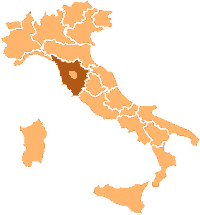
Chianti is a geographical area located south of Florence in central Italy. Chianti and Florence are both to be found in Tuscany which is one of Italy’s twenty political regions. Florence is the capital of Tuscany. See the map below, Tuscany in brown and dot in the middle is Chianti.


Due to Italy’s highly varied geography, the twenty regions also offer very different scenery, not to mention culture. Tuscany has been blessed by the gods, and is Italy’s (and perhaps the world’s) richest region in terms of art, architecture and culture. Not to mention the gorgeous scenery of Chianti and Val d’Orcia.

Excellent wines are produced here too, the most famous being Chianti and Brunello. There’s also an important amount of light industry and services. In fact though we know Tuscany best for tourism, culture and wine, these are secondary in gross income to industry.

Sunday, January 12, 2014

When to take my Photogaphy tour of the Val d’Orcia

Choosing the right time for your photographic tour of the Val d’Orcia is very important. The Val d'Orcia has ever changing colors depending on the farming cycles. The classic photos of green fields are taken from March to May. Then from June to mid July we have the gold of ripening wheat, and from mid July through October the less interesting time of brown ploughed fields. Be sure to keep these aspects in mind before booking your tour.

 As we all know, the best time for landscape photos is early morning and late afternoon.  Due to work commitments, I can’t offer these times. We instead arrive in the area about 11:00am, and leave around  5:00pm. The tour is therefore a compromise, If you’re looking for the dramatic scenes of the professionals, this isn’t the tour for you. By the way, even the professionals sometimes need weeks to get the perfect picture.

The photos below are all taken by me with a compact digital camera. They were taken between 2:00pm and 4:30pm and represent what to expect if the weather is favorable.
Classic photo of the Val d'Orcia from March to May
Another important aspect to consider is; most of the famous sites have the sun looking into the camera in the morning, so the best landscape photos are to be had during the afternoon. How many scenes we photograph depends on how long we stay at each site. We can spend longer getting an alternative viewpoint, or be happy with the first shot. This choice is up to you and you may decide freely.
Classic Val d'Orcia photo mid June to mid July
Many people ask me about photos of Poppies. Well they bloom throughout May, but rarely do they grow in the same place twice, so I don’t know in advance where we’ll find them.
Classic Val d'Orcia photo in August
Another common request is for sunflower scenes. Unfortunately sunflower scenes are not part of the Val d’Orcia, the crop here is wheat, plus a small area of vineyards around Montalcino. We may however find some fields on our way south from Florence, and if the farmers have been kind to us, we may still get that much desired picture.
On the way to Val d'Orcia we found some sunflowers
So why take the tour with me? Well firstly there aren’t many offers for this type of tour…so you’re sort of stuck with me anyway. If you’re looking for professional results, I can't help you, however I believe there are a couple of professional photographers who may be able to help you, and they can be found on the net. If on the other hand you’re just a person who enjoys taking photos from time to time, then I’m the man to contact. I don’t profess to know every corner of the Val d’Orcia, but I’ve hunted down a number of the best scenes over the years and I’ll give you the benefit of my experience. You’ll get more with me in an afternoon than in several days on your own.

You could even turn your photography tour in a wine and photography tour. Take a look here:

Last but not least, be prepared for some discomfort, mud, dust, heat and the sharp cutting edges of the wheat when harvested. Bring comfortable but dispensable footwear.
The price of a good photo in Val d'Orcia


Sergio Ceccherini

Tuesday, March 19, 2013

Olive Oil from Tuscany

Olive oil from Tuscany is becoming ever more popular, and maybe you’ll want to try some while touring Italy, but you may be in for a surprise; the real McCoy tastes a lot different to what you may be used to.

The corporate companies that supply supermarkets have little concern for quality, despite what they publicize or write on the bottle. It’s a question of economics. A single tree will yield about six pints of high quality oil, and this is just too little if you need to produce huge quantities at low prices. So they resort to a number of nasty tricks to dilute the oil, or use otherwise unsuitable (rotting or fermenting) olives, then correct the inevitable faults chemically. As most industrial concerns producing cheap olive oil use the same methods, these oils have the same flavor, and maybe it’s the one your used too.  Unfortunately European legislation is just not strict enough, and it’s easy to fraud or even legally produce bad olive oil. I’ll not write a lengthy article on why this is, just take my word for it.

Typical color of newly milled Olive Oil
I’m betting you've never tasted a genuine high quality Olive oil from Tuscany, and when you do it can be quite a surprise. It’s bitter and fruity and doesn't have an exaggerated taste of olives. However if you taste an industrial oil side by side, the difference becomes immediately apparent. You’ll unlikely want the bad stuff again. The word most people use to describe the smell and flavor of industrial oils is, “rancid.”

 Fortunately there are a number of high quality producers in Tuscany, and some also have the DOP or IGP certification. These acronyms define the geographical origins of the oil, but more importantly that the oil has been tasted and analyzed by the authorities, who certify its quality. The oil is submitted for anonymous laboratory analysis, and is also subject to a blind tasting by a panel of experts. Only if it passes both tests is the company allowed to add DOP or IGP. When buying Italian olive oil back home look for the acronyms on the label.

A word on prices. I can’t say that paying a high price tag will guarantee you get quality olive oil, but a low price will definitely guarantee bad oil.

Click here to find out more about my Olive Oil and Wine tour.


Sergio Ceccherini

Friday, February 15, 2013

Touring Tuscany (Chianti) by Bus

To see the best of Chianti and more of it in a single day, you really do need hire someone who knows the area well. That’s expensive I know, so here’s a cheaper way to go about things. 

Fortunately at least one scenic Chianti wine road the “Chiantigiana,” is served by bus line. You can catch the bus at the main bus station in Florence (near the main rail station). The line to look for is the 365 for Gaiole - Castellina - Panzano - Greve (via Ferrone/Strada) - Firenze. You’d be best going directly to the station for times and info, as their site (Bus Italia Nord) seems to be in Italian only. However there is an on line timetable if you know Italian. 

It's a pleasant trip of about an hour from Florence to Panzano, which is where I suggest you make your first and southern most stop. Take a walk up the steep main street of the village to a delightful enoteca (wine shop) called Accademia del Buon Gusto (Piazza Ricasoli 11, +39 055 856 0159). A great wine tasting is available "without obligations". The owner Stefano Salvadori is a knowledgeable host, an expert on wines, and last but not least, quite a character. You’ll have a fun time and you'll probably end up buying something anyhow, but it needn't be expensive. For lunch you may like to try Dario Cecchini the Butcher's fast food joint. Dario Cecchini is another lively character who’s made a name for himself with the Chianti Hamburger. My opinion? Well it’s a huge hamburger, but why come all this way to eat a hamburger. I’d go for Tuscan home cooking at La Cantinetta Sassolini which just opposite the Accademia, mentioned above, or Oltre il Giardino near the main road. Just ask you can’t miss either of them. If you choose the suggested light lunch menus, you'll dine inexpensively too. 

To walk it all off, take the village street up to the church and follow it round to the left for some splendid views over the Conca d'Oro (Golden valley), one of Chianti’s most picturesque areas. Now take the bus back to Florence and Greve in Chianti the capital of Chianti Classico, and browse the arcaded piazza and a wine shop or two. You might also like to visit the “other” butcher’s shop “Falorni,” but this one I recommend. It’s famous for Tuscan specialties such as salami, prosciutto and sausages. Take another bus north one stop to Greti, and here you’ll find the roadside tasting room of Castello di Verrazzano. Maybe you could ask the bus driver to tell you when you arrive, they’re usually quite helpful. The address is Via Citille 32, Tel +39 055 854243, and it’s along the main road. It's free to taste here, and there are affordable bottles from this fine history making estate. 

Your DIY Tuscan Tour ends here and the last bus back to Florence leaves at 8 pm weekdays and 5 pm on Saturdays. Don’t bother on a Sunday. The bus fare will set you back about €10, which is a whole lot less than what I’d ask you. However if there are more of you, seven is the perfect number in order to spend the least, then for €55 you can have a luxurious day. 

Take a look here: Scenic Wine Tours in Tuscany.

Sergio Ceccherini

Sergio Ceccherini

Monday, February 11, 2013

A word about Tours in Tuscany (Chianti)

Chianti isn't just a wine, but a well defined region of central Tuscany and the wine takes its name from the region. The etymology of its name is open to debate, however it goes back many centuries. Worth noting is the production zone for Chianti wine reaches vastly further than the actual geographical boundaries. The geographical boundaries, are the lands between Florence to the North, and Siena to the South.

Chianti is synonymous to Tuscany, and when people say they’d like to tour Tuscany, they’re usually thinking of Chianti, not realizing that Tuscany is a vaster place of about 8,870 sq miles. However Chianti is by far (along with the Val d’Orcia), Tuscany’s prettiest and most Iconic region. Vineyards, old farmhouses, woodland and cypress trees, adorn the hills as far as the eye can see. Great attention is paid to the aesthetics of the land by farmers and vine growers, giving yet another element of engaging beauty.

Some think of Chianti as a place only for wine aficionados, but what a mistake! It’s one of the world’s most beautiful locations, and a must for anyone who enjoys splendid countryside or photography. I've been driving around Chianti most of my life, and I assure you I never tire of the scenery. After so many years I still do photographic tours of Chianti for my own enjoyment.

If you want to do your own scenic tour of Chianti, I suggest you start at the Tignanello vineyards where you can enjoy the panorama from the road. It’s not easy to find, but head for Santa Maria Macerata Greve in Chianti, and you’ll get there. Then go to Gabbiano Castle, for some more lovely photos of Chianti, they don’t mind if you browse around. After Gabbiano Castle, back track towards Quattro strade then take the secondary road to Panzano in Chianti. Take in the views from Panzano, then proceed to Radda in Chianti. For your return to Florence, head back via Greve in Chianti. This route will take you to see some splendid scenery.
The Tignanello Vineyard

If you’d like to take a tour with me, click on one of these for more info.


I've also put together a couple of tours for non wine drinkers. They combine a photographic safari of the Chianti landscapes, with visits to either San Gimignano or Siena.


Wednesday, June 20, 2012

" I don't want to go back to Florence."

Now here's a phrase I've heard more than once, and again just the other day from Paula and Rina (look up my facebook page). Not that there's anything wrong with Florence, if you exclude the noise, traffic, even noisier scooters, crowds and heat. So after a day in the relaxed open spaces of the Chianti countryside (with me of course), the thought of returning to it all is often daunting. With few exceptions it's back to your room with insufficient AC, (now everybody complains about this), and when you open the window for some air, you get blasted by a scooter, a bus, another scooter, yet another bus, and your olfactory senses delight in the fragrance of traffic fumes. Then out to dinner in a crowded restaurant, and later looking for somewhere to sit in a crowded cafe. Back to your room for a well earned night's sleep. Of course the scooters never sleep, and the loutish drunks yelling at the top of their obnoxious heads just have to let everyone know they're around.

So…if your coming to Italy to relax from the stress of your job and city life, you may not enjoy Florence that much. Sure a visit is an absolute must, I wouldn't dream of saying otherwise, but if your idea of a holiday is a quite room, where an open window means the breeze in the trees, and a cocktail by the pool with a view over Tuscan hills, you'd do well to forget Florence. So where do you want to go? Easy; just choose alternative accommodation in an agriturismo or villa in the spectacular countryside or in  the small picturesque towns of Chianti. There's an ample choice of varied accommodation, from basic and economic, to all out luxury.

However, lets' consider Florence again. I said Florence is a stressful city, but I didn't say it's to be avoided, how could I 12 million visitors can't be wrong? But if you're looking for peace and quite, the trick is to stay somewhere not too distant so you may get a bus or train into the city. If the accommodation is very remote, you may need a hire car, and if you really want to relax, then hire a driver guide like myself (why do you think I'm writing this article)? Another very important factor to consider, is the strategic position of Chianti to the rest of Tuscany. You'll no doubt want to do some touring, and Chianti is ideally located. You can easily tour Chianti itself, and you're within reasonable travel time to all the other must sees. Don't make the common mistake of judging travel times by your standards; roads in Tuscany are different. They're very busy, very windy and very slow. So a strategic position is important, for anyone wanting to do day tours, that don't involve endless hours sitting in a vehicle.

At this point why not look up a site or two that'll give you all the info you require to start considering your ideal accommodation. Here are some suggestions.

http://www.chianti.info/ Everything about Chianti, Italy
A travel guide for Chianti and Tuscany and accommodation.

http://www.bella-toscana.com/   Vacation accommodations in Tuscany
A huge selection of vacation accommodation in Tuscany, and lots of unusual but interesting info.

Wide selection of accommodation in Chianti, and info about Greve in Chianti too.


Sunday, March 11, 2012

Agriturismo in Loro Ciuffenna.

Loro Ciuffenna is a tiny but delightful town in the Valdarno region of Tuscany. The Valdarno is Chianti's "poorer" sister and little considered by visitors from America and Asia, but very popular with European and Italian holiday makers. It's located about an hour south east of Florence, and due to the rural nature of the region, a car will be necessary. However the Valdarno area is well served by train from the main towns of San Giovanni and Montevarchi. If you don't want to drive you can always hire a driver guide, and I live on the spot. You can find me here: Scenic Wine Tours in Tuscany.

Most of the accommodation in Loro Ciuffenna is "Agriturismo" (vacation accommodation on farms), with locations in rural and remote areas. Some Agriturismo in Loro Ciuffenna are rather basic, while others offer high levels of luxury and every comfort. The common denominator is a countryside location and self catering. However, the degree of extra services can vary greatly from basic to five star, but this is an option for your consideration and not a fault. You can save a lot of money in the basic Agriturismi, or spend more and be pampered to the full. By Italian law the farm should be operational, and in Loro Ciuffenna most are. A small number have little to do with farming, and could be classed as country hotels. Again this isn't a shortcoming, but an option to consider when making your choice.

Loro Ciuffenna a view of town
Why choose an Agriturismo in Loro Ciuffenna? Well prices are a little lower than in the other more popular areas, and if you're looking for peaceful isolated locations with stunning scenery, this is the place to be. It's also well away from the usual tourist routes, and you get a much closer feel of what everyday Tuscany is all about. 

The best scenery is to be had in the hills in and around Loro Ciuffenna, which also offers a breezy climate in summer. A Godsend after a day in Florence! The tiny but pretty town sits on a gorge, and offers a choice of three restaurants, a pizzeria and three bars for breakfast or evening aperitif, not to mention a first class Gelateria open in summer. On Saturday evenings during July and August the centre of town is closed off to traffic, and you can sit at a table with the locals enjoying a drink in the central piazza. If you're need  groceries for you meal back at the house, you'll find all you need in the local Supermarket and grocery store. The grocery store in particular, offers a wide choice of local goodies such as sheep's cheese, cold cuts and olive oil. They also have homemade precooked dishes well worth trying. An Agriturismo in the Loro Ciuffenna area will give you the advantage of an isolated refuge, while being close enough to a town that can cater for all your basic needs.

Saturday, March 10, 2012

Touring in Loro Ciuffena.

Many visitors don't take full advantage of Touring in Loro Ciuffenna. They assume they have to travel to the big guns elswhere, overlooking the treasures on the doorstep. This isn't really their a fault as little information is available in guide books, and even the local tourist board does little to promote the area, but that's where I come in. Take a look at my Cheese Making and Tuscan Olive Oil Tour and you'll see just how much the region has to offer. If you decide to forgoe the advantages of touring with me, I'll give you a few tips all the same.

Drive along the Setteponti  (seven bridges) road from Reggello to Loro Ciuffenna and you'll be treated to a  beautiful drive through neatly manicured, terraced olive orchards with outstanding views overlooking the Arno valley. If you drive slowly with stops for photos, it'll take just over an hour.

The Setteponti Road
Olive oil is the region's most important product, not only economically, but culturally. Certainly. Here it's more important than wine. You'll see a couple of mills during your drive, and If you want to taste genuine olive oil and not the stuff you find in supermarkets, then you couldn't be in a better place. You could try Santa Tea mill in Reggello, who do tastings and guided tours. Alternatively, buy a small bottle at a local grocery store, they always stock the genuine article. Remember they have to sell to the locals who are all savvy when it come to olive oil. Ask for oil from Gropina, you can't get more local than this, and I assure you it's the real McCoy. Expect a price tag of 8-12 euro per litre.

Another gastronomical delight is sheep's cheese made by the small artisanal dairies of the region. No industries here. Again try a local grocer (not supermarket) and ask for "Pecorino Locale." Pair it with a glass or two of Chianti, a piece of Tuscan bread - broken not sliced, and it's a feast for a king.

Walk around the village of Loro Ciuffenna where you'll have some great photo opportunities,  and be sure to cross the Ponte Romanico (Romanesque Bridge) for a view over the gorge. Ask any local to point it out. You might like to have lunch in Loro too. You can choose from a frugal but tasty snack at the Bar Centrale in the piazza (closed Tuesdays), or one of the three restaurants all within a minute's walk.

Then from Loro Ciuffenna, (locally just called Loro) head up into the mountains towards the tiny little mountain village of Trappola. It takes about fifteen minutes. The drive is spectacular with views of terraced olive orchards and the Valdarno (Arno Valley) in the distance. Walk around the ancient village of Trappola, and again enjoy the splendid views and absolute peace away from cars and crowds. You'll probably be the only tourists too, and the locals are always friendly towards the few visitors they receive. There's a rustic bar/restaurant called Vin' de Nuvoli were you can get an economical bite to eat. Maybe the cheese and wine I suggested earlier. Actually they have a well stocked wine cellar, you could try something special too. It's open 7/7 from May to September.

Around six in the evening head down to San Giovanni Valdarno (twenty minutes from Loro) and  join the locals for their evening stroll in Corso Italia (Main Street). The object is to walk slowly form one end of the street to the other more than once, while conversing, people watching, having  a gelato and browsing the shop windows. The town is also architecturally interesting, so don't forget to look around and up. Last but definitely not least…take it easy just like the locals.

copyright Sergio Ceccherini © Scenic Wine Tours in Tuscany 2012. All rights reserved.